
Online: An introduction to the CRIRSCO family of reporting codes – All Modules
Online: An introduction to the CRIRSCO family of reporting codes – All Modules
This series of courses is intended as a general overview and refresher course for professionals who are practising, or who aspire to practice, as Competent Persons (or who provide support to Competent Persons) for the purposes of Mineral Reporting. It would also be suitable for those with a more general interest in international reporting on mineral assets, including people involved in management of mining companies and consultancies, financial advisors and investors.
Since the late 1980s, public reporting of Exploration Results, Mineral Resources and Mineral Reserves has been governed by a variety of different reporting codes and standards, including: the PERC Reporting Standard (Europe), JORC Code (Australasia); NI 43 101 legislation and CIM Definition Standards and best practice guidelines (Canada), SAMREC (South Africa), SEC Industry Guide 7 (US) and others.
Since 1994, under the auspices of CRIRSCO (Committee for Mineral Reserves International Reporting Standards) there has been considerable cooperation between the main bodies involved in the development of the different codes and standards and a move towards standardisation of the definitions of key terms. This course provides an introduction to the principles underlying the reporting codes and standards with particular reference to the PERC Reporting Standard 2021.
The focus of the course will be on Public Reporting of minerals projects in compliance with the CRIRSCO international reporting standards. The background to the need for standard definitions of the terminology used, the different types of reporting systems that exist, and the specific requirements of stock exchange disclosure in the context of investor protection, will be explained. Whilst the main focus will be on the role and responsibilities of the Competent Person when preparing assessments and reports in compliance with the PERC Reporting Standard 2021, most of the course content will be equally applicable to those working towards reporting under other CRIRSCO-aligned systems. Reference will be made to the use of the NI 43-101 Form F1 table of contents and Table 1 checklist in the PERC Reporting Standard as a framework for preparing technical reports (Most of the CRIRSCO-aligned codes and standards, including the JORC Code, contain a Table 1 checklist with similar content to the one in the PERC Reporting Standard).
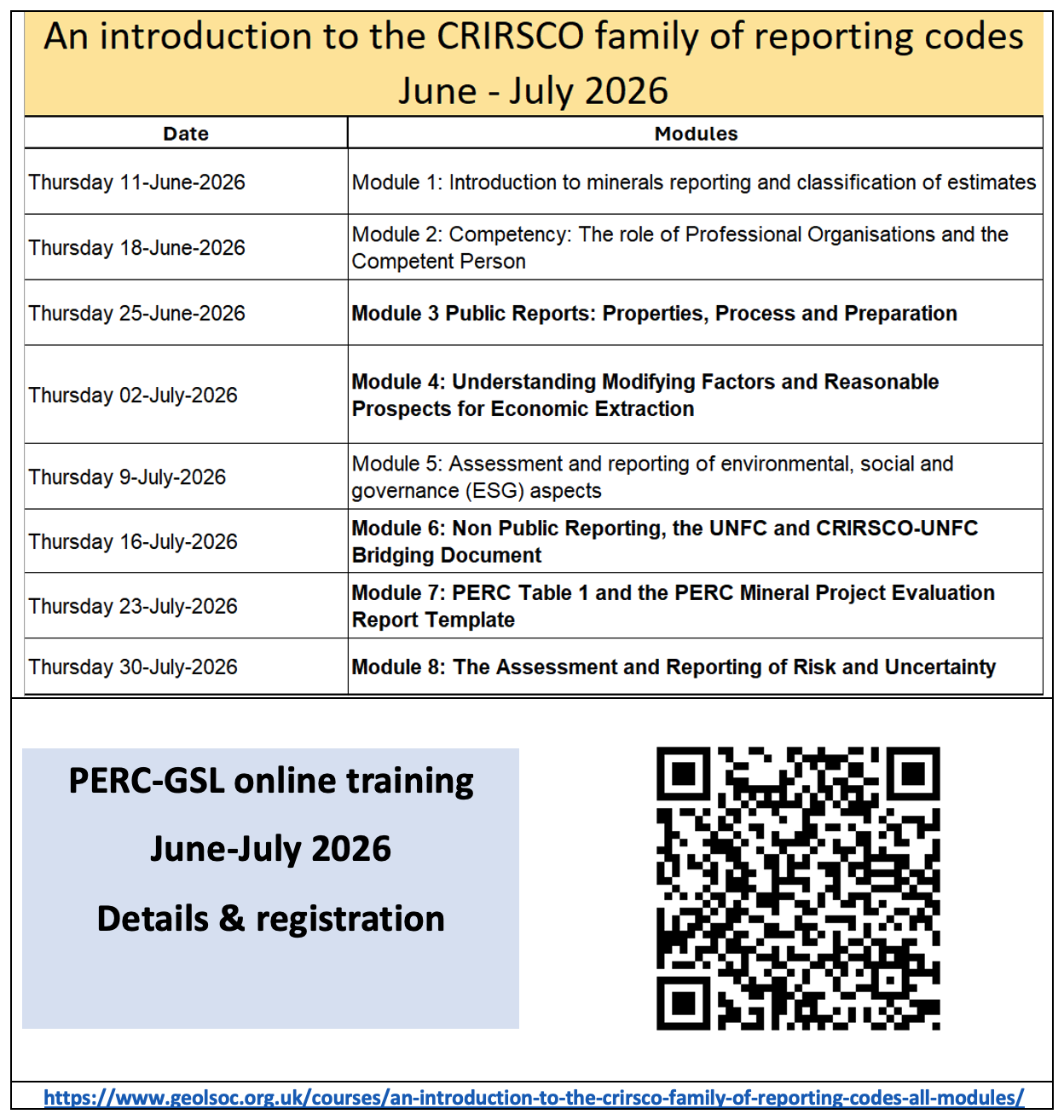
Courses will be held virtually over 8 modules on the following dates (Thursdays), starting at 16:00 GMT and ending at approximately 17:30 GMT, depending on audience participation.
- Module 1: 11 June
- Module 2: 18 June
- Module 3: 25 June
- Module 4: 2 July
- Module 5: 9 July
- Module 6: 16 July
- Module 7: 23 July
- Module 8: 30 July
Module 1: Introduction to minerals reporting and classification of estimates - 11 June
An introduction to the history and development of the CRIRSCO-aligned international reporting codes and standards for public reporting (disclosure) on mineral projects, why they were needed, what they are, and what they do. An explanation is provided about how the CRIRSCO-aligned codes relate to other reporting systems which are designed for different purposes. An overview of how Mineral estimates are divided the different categories and classified according to confidence levels, and what this classification means for public reporting is also provided.
Learning objectives:
- The role and organisational structures of PERC and CRIRSCO;
- The importance of having reporting codes and standards;
- The need for different reporting systems for investors and government;
- The role of mining professionals in the assessment and reporting process;
- To recognise and understand some of the important concepts of PERC/CRIRSCO reporting;
Registration: https://www.geolsoc.org.uk/courses/crirsco-module-1-introduction-to-minerals-reporting-and-classification-of-estimates/
Module 2: Competency: The role of Professional Organisations and the Competent Person - 18 June
What is competency and why is it necessary, and what is the relationship to professional organisations?
Learning objectives:
- Learn what is meant by the term Competent Person (CP)
- The importance of competency in the context of the CRIRSCO reporting codes and standards
- Understand the qualification and experience requirements needed to act as a CRIRSCO CP
- Understand what Competent Person’s Reports and Consents are
- Become aware of possible sanctions for misreporting
Module 3: Public Reports: Properties, Process and Preparation - 25 June
An introduction to the different types of report that are prepared during the assessment of mineral asset, including, sources of information and intended audiences. An explanation of what Public Reports are in the context of CRIRSCO-aligned reporting, what they are used for, what they contain, and what information should be included or excluded from them. An overview of the concept, historical development and current contents of Table 1.
Learning objectives:
- To understand the properties of a Public Report, what it represents, the different types, different content sources, and different intended use or application;
- To clarify the different approaches to compilation in different jurisdictions, and how that impacts the practical compilation of a Public Report;
- To understand the compilation process in terms of who contributes what;
- To clarify the Competent Person’s role, responsibility, liability, and consent, as well as that of the Mineral Company;
- To learn and understand the different stages in the process from compilation to Public Reporting;
- To learn about using Table 1 as a framework for assessing the contents of a Public Report, as well as some practical hints on how to present information;
Registration: https://www.geolsoc.org.uk/courses/crirsco-module-3-public-reports-properties-process-and-preparation/
Module 4: Understanding Modifying Factors and Reasonable Prospects for Economic Extraction - 2 July
What are the Modifying Factors, why they are important, and how to use them to establish different levels of economic potential, with emphasis on defining “reasonable prospects for economic extraction” in the definition of Mineral Resource?
Learning objectives:
- To understand what Modifying Factors are, and how they impact on the business of mining;
- To clarify the different categories of Modifying Factors, and how they are referenced in the PERC Reporting Standard;
- To understand what Reference Points are, and why they are critical in understanding the impact of Modifying Factors;
- To demonstrate some practical outcomes of applying Modifying Factors in mine planning;
- To understand the role of Technical Studies in assessing Modifying Factors:
- To learn how Modifying Factors are used to define ‘reasonable prospects of economic extraction’ (RPEE) in declaring a Mineral Resource;
- How to present and report Modifying Factors for RPEE in a Public Report;
Module 5: Consideration of ESG Aspects in Minerals Reporting - 9 July
An overview of why the assessment of Environmental, Social and Governance (ESG) aspects has become a key concern, understanding what is meant by ESG in a minerals’ reporting context, how it is addressed in the PERC Reporting Standard, and a review of some relevant mining-related ESG standards.
Learning objectives:
- Understand why ESG has become a key concern of investors in recent years
- Understand what is meant by environmental, social and governance (ESG) aspects in a minerals reporting context
- Become familiar with how ESG has been addressed in the PERC Reporting Standard
- Be introduced to some relevant mining related ESG standards
Module 6: Non-Public Reporting, the UNFC and CRIRSCO Template to UNFC Bridging Document - 16 July
What the United Nations Framework Classification for Resources (UNFC) is, why it is important, how it differs from the CRIRSCO-type codes, how the two classification systems can be correlated with each other using the CRIRSCO Template to UNFC Bridging Document, and the application of the two systems for strategic and non-public reporting.
Learning objectives:
- To understand the differences between the UNFC and CRIRSCO-type classification systems;
- How the UNFC system works, how the three-dimensional EFG axes are constructed and what they mean;
- To understand the difference between a Project-based and a Mineral Category-based classification in the UNFC;
- To understand the use of the Bridging Document between the UNFC and CRIRSCO;
- An overview of some case studies illustrating the application of the UNFC in different contexts.
Registration: https://www.geolsoc.org.uk/courses/crirsco-module-6-non-public-reporting-the-unfc-and-crirsco-unfc-bridging-document/
Module 7: PERC Table 1 and the Mineral Project Evaluation Report Template - 23 July
An overview of the concept, historical development and current contents of Table 1 and an introduction and overview of the MPER template document designed to aid the compilation of Mineral Project data for all reporting purposes, and how it relates to a Competent Person’s Report.
Learning objectives:
- To understand the MPER Template and its role as a foundation document to support both Public and Non-Public reporting;
- To understand the practical transformation of Table 1 into a document template;
- To explain the MPER structure and format, its similarities and differences to Table 1;
- To understand the concept of a Mineral Project living document throughout the entire Mineral Asset Development cycle;
- To explain the relationship between the MPER and a Competent Person’s Report;
Registration: https://www.geolsoc.org.uk/courses/crirsco-module-7-perc-table-1-and-the-perc-mineral-project-evaluation-report-template/
Module 8: The Assessment and Reporting of Risk and Uncertainty - 30 July
The importance of identifying risk and uncertainty in a Mineral Project, how they are defined, assessed and ranked, and how these should be addressed in public reporting of Mineral Resources and Mineral Reserves.
Learning objectives
- How Uncertainty leads to Risk, and the impact this has on expected outcomes;
- To clarify the different types of Risk and their tolerances;
- To understand the relationship between consequence and likelihood of unwanted events;
- How to quantify Risk in practice, the Risk Management process in terms of assessment, identification and mitigation, including some examples;
- How to evaluate, analyse and report Risk, including using Table 1 as a framework;
- How to evaluate Historical Data, the Risk it represents, and the use of Review and Audit procedures for validation and concurrency;
- To propose some practical Recommendations and obligations when considering using Historical Data;
Registration: https://www.geolsoc.org.uk/courses/crirsco-module-8-the-assessment-and-reporting-of-risk-and-uncertainty/